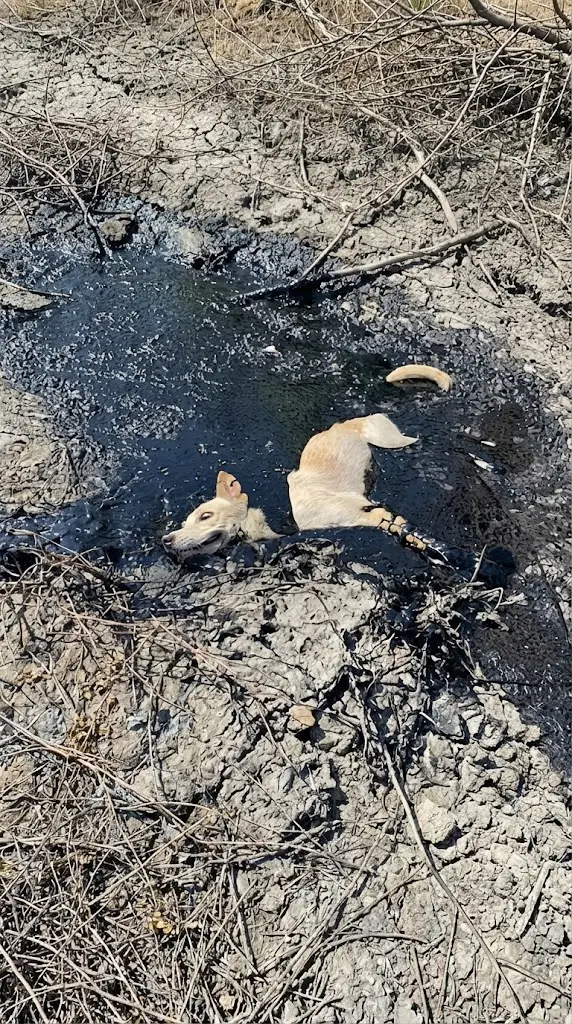
Mali, a small light-brown stray dog in Nakhon Nayok, Thailand, faced near-certain disaster when a single misstep caused her to fall into a pool of molten rubberized asphalt — a dangerous industrial byproduct carelessly left behind at a local industrial estate. With only her mouth above the surface, her life hung in the balance until strangers intervened with quick thinking and a delicate rescue operation.
The Incident: From Familiar Paths to a Hazardous Trap
Used to roaming the dusty grounds of an industrial estate—marked by silos, idle machinery, and humming factories—Mali had safely navigated the area many times before. Yet that day, as she stepped onto what appeared to be solid ground near a large silo, the earth suddenly gave way. Beneath her was a sticky, hot pool of rubberized asphalt left from road repair work, a thick industrial waste substance with no regard for animals passing through.
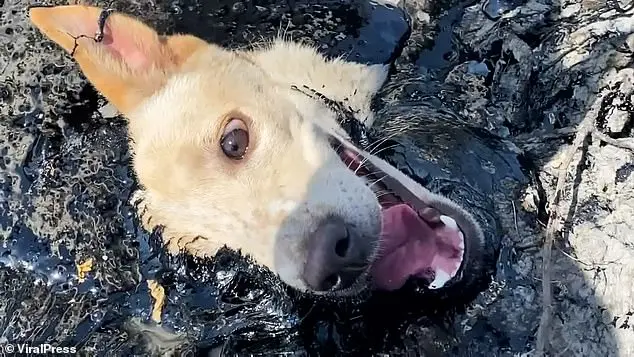
This asphalt was not only scorching but viscous and unyielding. Each desperate effort Mali made to escape only caused her to sink deeper into the substance. When she was discovered, she was almost completely trapped, with barely her mouth visible above the hardened surface—still gasping for air.
A Bystander’s Dilemma and the Call for Help
Supatra Baisri, a 30-year-old man passing nearby, was the first to hear faint sounds of distress. Approaching cautiously, he saw only frightened eyes and a nose poking just above the black, solid mass. Understanding the extreme danger, he knew attempting to reach Mali by hand risked trapping himself in the thick asphalt. “I would have been stuck as well,” he later stated, explaining why he kept his distance and called emergency services immediately.
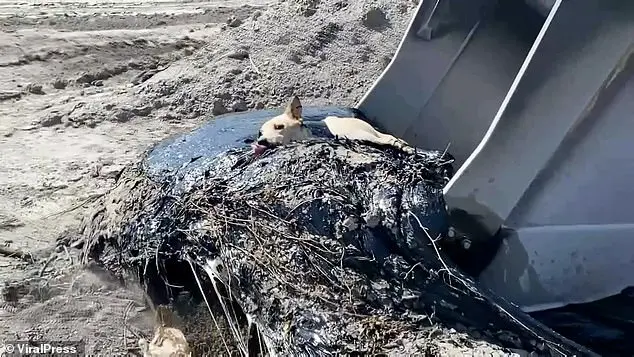
Because the asphalt had partially cooled into a hardened shell, rescuers needed heavy machinery to avoid injuring Mali during extraction. They arrived with an excavator—the only equipment capable of carefully lifting the thick material without further harm. Workers nearby admitted that the rubberized asphalt had been dumped thoughtlessly without consideration for stray dogs that frequently traversed the site.
Video: Stray Dog Freed After Two Hours Trapped in Molten Asphalt
A Grueling Rescue Under Time Pressure
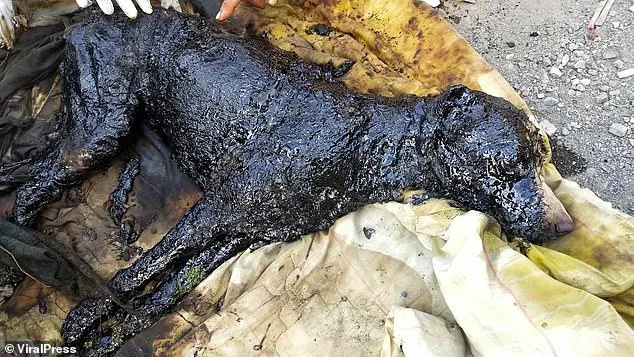
The rescue unfolded over two tense hours, marked by precision and patience. The excavator operator worked incrementally, lifting pieces of the toughened asphalt inch by inch to expose Mali’s delicate body beneath. When finally free, it was clear nearly half of her body was encased in a solid black layer of cooled asphalt, beginning to tighten painfully around her skin.
Workers from a nearby factory promptly applied solvents to carefully dissolve the sticky material from her fur. This painstaking process had to be done swiftly; any delay could have resulted in the material fully hardening and causing severe damage to her skin during removal.
Recovery and the Risks of Industrial Negligence
Mali was taken to a veterinary clinic where she received a thorough cleaning and examination. Remarkably, she had no life-threatening injuries despite the severity of her ordeal. Wrapped in warm blankets and comforted with food and water, her tail soon began to wag, revealing a resilient and gentle spirit emerging from trauma.
The veterinary staff issued a strong warning about the dangers posed by improper disposal of industrial waste. One vet emphasized that Mali’s survival depended on timely rescue and that without someone noticing her distress she likely would have perished. This incident spotlighted the very real risk such negligence poses to animals sharing human environments.
The Lessons and Legacy Mali Leaves Behind
Mali’s story highlights the profound consequences of careless industrial waste disposal. What may seem like harmless debris to some can silently turn into deadly traps for stray animals. At the same time, her rescue illustrates the ripple effect of compassion: a passerby who noticed her plight, emergency responders equipped for the task, and workers ready to help—combining forces to save a life that could not cry out in words.
Now free from the suffocating layers of rubber that nearly claimed her, Mali stands as living proof that hope can endure even in the darkest, stickiest circumstances.

Her survival urges all of us to be vigilant about the spaces we inhabit and the waste we leave behind, reminding us to look carefully at the ground beneath our feet—for the safety of all creatures, especially those who cannot speak for themselves.