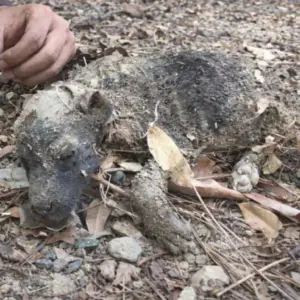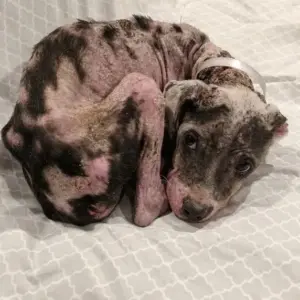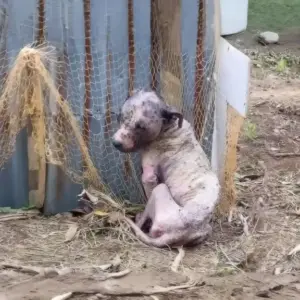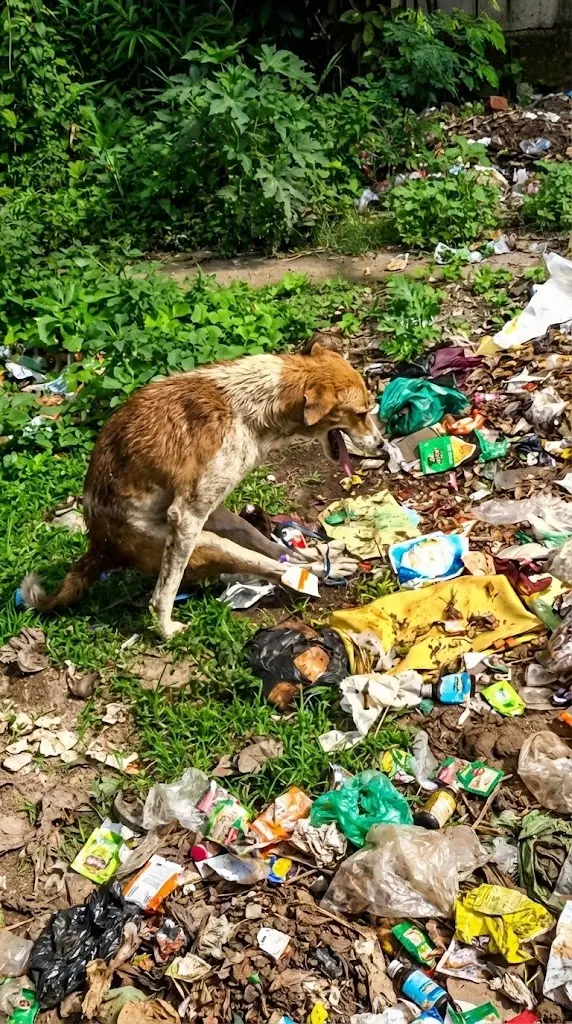
Comfy arrived with two significant challenges—one visible and one hidden. Physically, his back legs were immobile due to spinal damage, and his muscles were quickly weakening, threatening any chance of recovery without immediate care. More difficult to address, however, was the emotional barrier he carried. His hind legs had been loosely tied together before rescue, leaving him not with an obvious wound, but with a deep-seated fear of human touch.
His caretakers chose the name Comfy with hope, initially interpreting his quiet stillness as calmness and peace. But this tranquility masked a story of pain and mistrust that would soon become painfully clear as Comfy began to regain some strength.
The Hidden Struggle Behind Comfy’s Stillness
As the effects of pain medication subsided, Comfy’s behavior shifted noticeably. Any approach was met with growling and sharp warnings, a clear signal: keep your distance. The team quickly learned that his defensiveness was not aggression meant to cause harm but a response to a history where human contact had meant restraint and pain. This distinction was important, yet it complicated the already challenging task of his rehabilitation.
Facing an Unsolvable Dilemma
For a dog with paralysis, consistent physiotherapy is crucial to stimulate nerves, maintain muscle function, and prevent irreversible atrophy. Therapy could not be delayed until Comfy felt ready. Yet, Comfy’s justified fear prevented any hands-on treatment. The team faced a painful choice: forcibly administer therapy and risk deepening his fear, or delay intervention and risk his body deteriorating beyond repair.
They chose patience. They decided not to force touch, despite the urgency, and instead committed to the harder path: waiting.
Video: How Patience Helped Comfy Heal and Trust Again
Patience in Practice: The Road to Trust
The team’s approach was gentle and steadfast. Staff members spent time near Comfy without attempting to touch him, placing food within reach rather than offering it by hand. Their voices remained low and soothing, creating an environment where their presence was no longer a prelude to pain. They respected his boundaries, consistently showing up but never pushing past his comfort zone.
Progress was measured in the smallest signs. Some days brought no growls. Others saw Comfy remain still rather than retreat when someone sat nearby. The turning point came quietly: a brief flick of his tail. This subtle movement was not a warning but a new form of communication—an opening in the door he had kept locked for so long.
Building Bridges with Touch
As trust grew, Comfy allowed gradual contact. A hand would rest near him, then briefly on his body, before more sustained touch for the therapy he needed. Each session devoid of pain reinforced a new lesson contradicting his past: that human hands could be safe and healing. The road to recovery was slow and demanding. Comfy’s muscles had deteriorated significantly, and maintaining balance required all his concentration. Some therapy days ended in exhaustion, necessitating careful rest before continuing.
Neither Comfy nor the team gave up.
Six Months to a New Beginning
At the six-month milestone, Comfy’s transformation became undeniable. He stood unaided on the legs that had once been entirely useless. Each step was uneven and required intense effort, but it was his own. Soon, those steps multiplied, and eventually, Comfy experienced something profoundly moving—he ran. Not cautiously or hesitantly, but with a joyous freedom that celebrated rediscovered mobility and vitality. The staff affectionately dubbed him “the Joyful Jogger.”
Understanding the Roots of Fear and Healing
Comfy’s defensive behavior was not distrust in absence but distrust shaped by past hurt. His wariness was a protective measure, learned through painful experience, to safeguard himself with growls and distance. This differed from a dog that never connected to humans at all. Comfy had known connection but had been damaged by it.
The team’s patience was more than training—it was direct evidence to help rewrite Comfy’s understanding of touch. Consistent, gentle presence showed him that hands nearby did not mean harm; gradual touch showed safety; sustained therapy showed he could regain strength. Day by day, with quiet persistence, the team made this case, and Comfy listened. Eventually, he believed.
And once belief took root, everything changed. Comfy ran free, embodying a journey of healing that required far more than physical therapy—it demanded patience, respect, and trust.